-
-
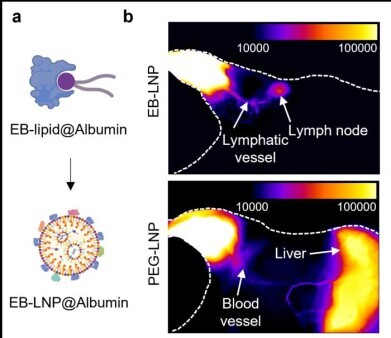 An albumin-recruiting lipid nanoparticle (EB-LNP) formulation promotes lymphatic drainage while avoiding liver accumulation compared to traditional LNP system (PEG-LNP). a, The molecular complex formed between Evans Blue-modified lipid and albumin. Evans Blue-modified lipid was employed to prepare EB-LNP using microfluidic device. b, In vivo fluorescence imaging of mice following intramuscular injection of EB-LNP or PEG-LNP labelled with a near-infrared probe, demonstrating the different biodistribution and tissue accumulation. Credit: NUS Medicine
Research news
Albumin-hitchhiking lipid nanoparticles target lymph nodes to boost mRNA vaccine safety
Dec 01 2025
A joint Singaporean-Chinese research team has developed an Evans Blue-modified lipid nanoparticle platform that directs mRNA vaccines to lymph nodes, reduces liver exposure and enhances antitumour and antiviral responses
A team from the Yong Loo Lin School of Medicine at the National University of Singapore (NUS) and Tsinghua University, Beijing, China has reported a novel messenger ribonucleic acid (mRNA) vaccine delivery technology that has the potential to make future vaccines safer and more effective.
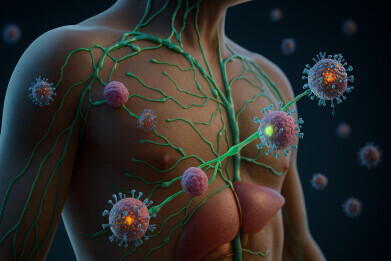
The work describes an albumin-recruiting lipid nanoparticle system – termed Evans Blue-modified lipid nanoparticles (EB-LNPs) – that delivers mRNA directly to lymph nodes, the immune system’s ‘command centres’.
The platform largely bypasses the liver, by design, which is a major site of accumulation with the potential therefore for toxicity for current lipid nanoparticle vaccines. In preclinical models, the approach has outperformed conventional systems in both cancer therapy and protection against viral infection, including melanoma, human papillomavirus related cancers, H1N1 influenza and the Omicron variant of the SARS-CoV-2 virus that causes COVID-19.
“Traditional lipid nanoparticle-based vaccines can accumulate in the liver after intramuscular injection, raising the risk of liver damage and dampening immune responses,” explained Professor Shawn Chen Xiaoyuan, co-senior author of the paper from the Department of Diagnostic Radiology and the Nanomedicine Translational Research Programme at NUS.
“We aimed to design a smarter delivery system that avoids this problem and directs the vaccine exactly where it is needed,” he added.
mRNA vaccines depend on efficient delivery to immune tissues so that antigen-presenting cells in lymph nodes can take up the genetic instructions and prime T and B cells. Conventional polyethylene glycol lipid nanoparticle (PEG-LNP) systems, however, often accumulate in the liver after systemic or intramuscular administration.
Lipid nanoparticles are formulated at nanometre scale in order to carry mRNA or other therapeutics into cells. In an oncology setting the repeated high doses which are often required can provoke inflammation, liver injury or even anaphylaxis.
To address this, the team exploited albumin, a natural transport protein that circulates at high concentration in blood and lymph. The researchers engineered a lipid component that binds tightly to albumin so that, once administered, the nanoparticles ‘hitchhike’ on endogenous albumin molecules.
This strategy channels the mRNA payload through the lymphatic system into lymph nodes, where immune cells can process the vaccine material. As a result, far less material is in general circulation or reaches the liver.
The group synthesised a specific Evans Blue-modified lipid with high affinity for albumin. When formulated into EB-LNPs and injected intramuscularly, these nanoparticles recruited albumin to their surface, which in turn guided them preferentially to lymph nodes rather than the liver. Even at comparatively low doses, EB-LNP vaccines induced strong antitumour T-cell responses and high titres of neutralising antibodies in preclinical models.
Notably, the investigators reported no evidence of liver inflammation or broader toxic effects, even with repeated administrations. Unlike traditional PEG-LNP formulations, EB-LNPs did not drive robust anti-drug antibody formation which can undermine both safety and efficacy when patients need multiple doses.
“This albumin-hitchhiking strategy represents a paradigm shift in mRNA vaccine delivery,” said Assistant Professor Guocan Yu of the Key Laboratory of Bioorganic Phosphorus Chemistry and Chemical Biology in the Department of Chemistry at Tsinghua University.
“It has broad implications for cancer, infectious diseases and potentially autoimmune disorders. For patients, that means fewer injections, reduced side effects and longer-lasting protection,” he said.
By directing mRNA cargo into lymph nodes, EB-LNPs appear to increase the ‘quality’ of the immune response as well as its magnitude. Lymph nodes contain dense networks of antigen-presenting cells and T and B lymphocytes; a delivery system that concentrates antigen there, rather than in off-target organs, would be expected to improve vaccine efficiency. At the same time, reduced exposure of liver tissue and other organs offers a plausible mechanistic explanation for the improved safety profile observed in the study.
The research team is now set to progress to clinical trials in order to establish safety and efficacy in humans. The investigators intend to extend the platform to additional indications, including autoimmune diseases and lymphatic cancers, and to explore combination regimens that pair EB-LNPs with other immunotherapies such as checkpoint inhibitors. They also plan to collaborate with industry partners to scale up manufacturing processes and to integrate EB-LNP design principles into future mRNA vaccine pipelines.
“Our hope is to transform how mRNA vaccines are designed, making them safer, more effective and easier to administer,” said Dr. Pei Huang, co-lead author of the paper and research fellow at the Department of Diagnostic Radiology and the Nanomedicine Translational Research Programme at NUS, Singapore.
“If we can send the vaccine straight to the immune system’s command posts while sparing vulnerable organs, we can improve both patient experience and clinical outcomes,” she said.
For further reading please visit: 10.1038/s41563-025-02284-w


Digital Edition
Lab Asia Dec 2025
December 2025
Chromatography Articles- Cutting-edge sample preparation tools help laboratories to stay ahead of the curveMass Spectrometry & Spectroscopy Articles- Unlocking the complexity of metabolomics: Pushi...
View all digital editions









Events
Jan 21 2026 Tokyo, Japan
Jan 28 2026 Tokyo, Japan
Jan 29 2026 New Delhi, India
Feb 07 2026 Boston, MA, USA
Asia Pharma Expo/Asia Lab Expo
Feb 12 2026 Dhaka, Bangladesh




