Laboratory events news
ELRIG 2025: Recursion's high content imaging and AI platform promises to reboot efficiency in drug discovery
Nov 20 2025
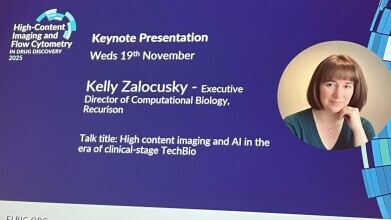
At ELRIG’s 2025 meeting in GSK’s Stevenage campus, Recursion’s Executive Director of Computational Biology, Dr. Kelly Zalocusky, set out how its large-scale, high-content imaging – integrated with artificial intelligence and automated laboratories – has created a phenomic ‘data atlas’ that is yielding clinical-stage oncology programmes.
Dr. Kelly Zalocusky of Recursion delivered the keynote address to the ELRIG conference at GSK’s Stevenage campus in November 2025 and outlined how the firm is leveraging large-scale, high-content imaging and artificial intelligence (AI) in its research and development (R&D) to build productivity in the biopharmaceutical sector.
In her keynote address, Dr. Zalocusky, who is the executive director of computational biology at Recursion, described how the company has spent more than a decade building an industrial scale ‘TechBio’ platform that now supports clinical-stage assets and enables their strategic partnerships.
She opened her presentation by describing Recursion’s core mission, which is to decode biology in order to improve human health, and emphasised that the organisation treats this as a problem of engineering and data as much as one of biology. Recursion operates large, automated laboratories at its headquarters in Salt Lake City, Utah, US, alongside further facilities at Oxford in the UK.
Across these sites, the company can now conduct more than two million experiments each week, with assays that combine high content cellular imaging, transcriptomics and additional molecular readouts. Those data feed state-of-the-art computer vision systems, machine learning models and broader AI approaches that support candidate drug identification, molecular design and clinical decision making.
“Every day that can [be cut] from the discovery and development timeline is a day that patients do not have to wait [for treatment],” said Dr. Zalocusky. She added that if technology can reduce the cost and risk of drug discovery, those gains should ultimately translate into faster access to effective medicines for patients in clinic.
Dr. Zalocusky set Recursion’s approach against the backdrop of Eroom’s law, which names the long-term trend in drug discovery that has seen a steep fall in the number of new molecular entities moving into development per billion dollars of pharmaceutical R&D spending, adjusted for inflation. Even on a logarithmic scale, the data still shows a sharp decline in the curve of productivity across roughly six decades of pharmaceutical research.
Although the plot has flattened slightly in recent years, she suggested that, overall, the industry remains at far-from-satisfactory levels of efficiency. In stark contrast, she pointed to advances in silicon chips, where Moore’s law for computation has transformed what is possible in a matter of years rather than decades. It describes the empirical trend that held for several decades – and acted as a roadmap for the semiconductor industry – where the number of transistors on an integrated circuit roughly doubles about every two years.
Alongside this, the speed at which AI agents can complete complex tasks relative to the speed of human experts is believed to double every six months. The gap between stagnant R&D productivity and explosive growth in computational power and AI therefore defines – in her view – a large space of opportunity for those who can apply technology to biology and chemistry in an effective, disciplined way.
Dr. Zalocusky detailed how Recursion established the data foundation that makes its scientific strategies possible. Around twelve years ago, the company committed to high-content imaging at scale, with a central role for the ‘cell painting’ assay. Cell painting uses a small set of fluorescent dyes to label major cellular structures. This approach yields a rich yet standardised view of cell morphology and subcellular organisation. Crucially, it is relatively inexpensive and inherently scalable, so it can support the hundreds of millions of images that computer vision in biology now requires.
Within the organisation, AI sits at the centre of three interlocking modules in the company’s drug discovery and development strategy. “The first module focuses on deep biological understanding. Large-scale phenotypic imaging and transcriptomic datasets feed models that propose novel targets [for drug interaction] and de-risk those targets as early as possible, through a process the company describes as ‘patient connectivity’.” In this context, patient connectivity refers to evidence that a target – and its perturbation – actually map onto real disease biology rather than artefacts of an in vitro system.
The second module then applies AI to the design of molecules themselves with the explicit aim to generate more drug-like small molecules with superior properties, fewer ‘design–make–test’ cycles and many fewer synthesised compounds than a traditional medicinal-chemistry workflow would typically have required.
The third module focuses on clinical technologies that support the randomised clinical trials (RCT) process – a regulatory requirement – with tools that aid patient and site selection as well as faster recruitment to RCTs. The goal is to shorten timelines and raise the probability of success when a candidate drug enters the clinical development phases. Across all three modules, AI now plays a key role. It no longer only analyses existing datasets but increasingly generates hypotheses, designs novel compounds and proposes specific experiments. Because these experimental decisions are automated and fully recorded, data from both successes and failures become structured inputs for further model training, with the potential for the platform to improve with each cycle.
The backbone of Recursion’s platform is what she called its ‘data atlas’ of cellular phenotypes. This atlas comprises hundreds of millions of images of cells, all generated in a fully automated high-throughput laboratory on 1,536-well plates with an identical control structure for each plate. The atlas now spans dozens of human cell types and incorporates whole-genome CRISPR knock-out screens, alongside more than a million small-molecule compounds.
Additional perturbation modalities, such as antisense oligonucleotides or viral expression constructs, enter the same unified experimental framework, with the same quality controls. This consistency allows data that the company built-up from 2015 onwards to remain directly comparable with images collected today.
To illustrate the sort of biological structure that emerges from this dataset, Dr. Zalocusky described a phenomic map derived from CRISPR knock-outs in human primary epithelial cells. In this representation, each gene knock-out has an associated high-dimensional morphological fingerprint. The map encodes the strength of relationship between every pair of CRISPR knock-outs. In the heatmap generated by the system, deep red values indicate high similarity in phenotypic space and often correspond to components of the same protein complex or pathway. By contrast, deep blue values indicate dissimilarity and often reflect negative relationships within a shared pathway.
Highlighting the JAK–STAT pathway as an example, Dr. Zalocusky spoke to how knock-outs of JAK1, STAT3 and interleukin-signalling components clustered in deep red, whereas SOCS3 showed strong negative correlation, consistent with its role as an inhibitory regulator of the pathway.
The same approach extends to pharmaceuticals and chemical matter. Recursion profiles compounds under the cell painting assay, which allows the organisation to identify molecules that produce phenotypes similar to a given gene knock-out or, conversely, phenotypes opposite to that knock-out. This turns aspects of target-and-hit identification into a form of search: scientists can query the atlas for compounds that resemble loss of function of a disease gene or for genes that resemble the effect of a compound with desirable pharmacology. Similarity between compounds within the atlas supports mechanism-of-action predictions. If an uncharacterised molecule clusters with known inhibitors of a pathway, that pattern offers an initial mechanistic hypothesis.
Recursion has needed extensive investment in automation, standardisation and quality control (QC) to make these maps reliable. In its Salt Lake City laboratory, assays start in a tissue-culture core that has produced and cryopreserved trillions of cells. These cells seed high-density plates, which then culture for durations tailored to the cell type and the biological question. Each well receives a defined perturbation, which might consist of a CRISPR guide set, a specific concentration of compound, a soluble factor or a viral vector. At the end of the assay, cells undergo staining with the cell painting dyes and high content imaging.
Computer vision pipelines and foundation models then analyse the data. At peak utilisation, microscopes operate around the clock, for six days a week. Over roughly five years, Recursion has scaled from several dozen 384-well plates per week to around two thousand 1,536-well plates per week, representing a capacity increase of more than 100-times.
Randomisation has played a central role in this scaling process. High-dimensional imaging readouts can amplify subtle artefacts into apparently meaningful structures if one does not randomise at multiple levels. Recursion therefore randomises perturbations within plates and across plates and considers the allocation of plates across fleets of ten, fifteen or more microscopes, so that instrument-specific variation does not masquerade as biological signal. Experimental batching strategies incorporate these randomisation constraints from the outset, which – in turn – increases confidence in the patterns that are analysed downstream.
Standardisation and simplification of laboratory processes form a second pillar. Dr. Zalocusky pointed out that although it is intuitive to demand maximal precision from every instrument, it is important to understand which tolerances materially affect data quality. For instance, if the locations of wells on a 1,536-well plate vary within 100 micrometres, sub-micron alignment of a microscope stage yields little practical improvement. Furthermore, Recursion checks over requests for variations from standard media formulations or imaging protocols for individual cell types. Unless there is a compelling biological rationale, the organisation’s default position is to avoid additional complexity in favour of preserving the robustness and reproducibility of the core platform.
In-flight QC provides the third pillar of the platform. Recursion seeds the system with ‘sacrificial QC plates’ that travel through the platform alongside experimental plates and mirror production conditions as closely as possible. If the production assay involves dimethyl sulfoxide (DMSO)-solubilised compounds, the QC assay uses DMSO rather than a laboratory proxy. These plates help the team to detect problems such as clogged pins, misaligned stages or other failure modes before those issues have the chance to silently degrade data quality.
Automated metrics and plate-level heatmaps can flag candidate issues, but Dr. Zalocusky underlined that human judgement remains essential. Trained QC staff review the metrics and visualisations regularly. In her view, complete automation of quality assessment remains neither realistic nor desirable in such a complex system.
The reward for this long-term infrastructure investment is a very large and internally consistent dataset. Recursion has now run more than 250 million experiments across more than 50 human cell types. In neuroscience alone – which is Dr. Zalocusky’s area of study – the team has generated more than a trillion induced pluripotent stem cell (iPSC)-derived neurons and more than 100 billion microglia. Those efforts have produced what Recursion regards as the first phenomic maps in human neurons and, more recently, in microglia.
To keep pace with the expansion of the data atlas, the organisation has also invested heavily in computing infrastructure. Dr. Zalocusky described what she called the ‘milk and cookies problem’. More data creates a need for more compute which in turn means more powerful models and hardware which justifies the generation of further data. But it’s not so much of a problem as an opportunity given that she reported that a recent upgrade to the company’s AI training stack enabled a 25 per cent improvement in model performance within just two weeks, illustrating how infrastructure updates can increase existing dataset value.
She then moved from platform description to a concrete drug discovery example. Recursion’s RBM39 oncology programme served as a case study in how high-content imaging and AI can yield a clinically relevant target and compound series. Cyclin-dependent kinase 12 (CDK12), which regulates DNA damage response pathways, has attracted substantial interest as an oncology target. However, its close homology to cyclin-dependent kinase 13 (CDK13) has created a major challenge because of on-target toxicities.
Recursion’s phenomic maps indicated a strong relationship between CDK12 and RBM39, an RNA splicing and transcription regulator. According to Dr. Zalocusky, Recursion was the first group to publish on this relationship and multiple academic papers that have followed since have provided independent validation.
Rather than perform a bespoke screen from first principles, Recursion approached the problem as a search over its existing whole-genome CRISPR map. Scientists queried the atlas for genes that shared a phenotypic signature with CDK12. RBM39 emerged as a compelling candidate and then progressed into a formal programme of target identification and validation. In parallel, compound phenotypes within the atlas highlighted multiple hit series that showed similarity to both CDK12 and RBM39 knock-out profiles but did not resemble CDK13. A heatmap of one such compound showed clear similarity to CDK12 and RBM39 at several concentrations – but importantly, no similarity to CDK13.
Recursion applied its Matchmaker protein–ligand binding prediction model to confirm that these compounds did not simply represent another class of CDK12 inhibitors. Matchmaker suggested that particular hits were unlikely to bind CDK12. Biochemical CDK12 activity assays supported this view. Control compounds reduced CDK12 activity as concentration rose, whereas the Recursion hit compounds had minimal effect on CDK12 activity. Subsequent mechanistic work showed that these molecules act as degraders of RBM39 rather than inhibitors of CDK12.
In an ovarian cancer cell-derived xenograft (CDX) model, the lead compound produced significant tumour regression at higher doses. The RBM39 programme has now entered clinical development. The next data read-out is expected in the first half of 2026, which Dr. Zalocusky cited as evidence that the phenomic platform can generate novel and actionable targets that translate into real-world oncology projects.
In the final section of her talk, Dr. Zalocusky touched on Recursion’s collaboration with Roche and Genentech, in which the same high-content imaging and AI framework has supported work on disease-relevant neural and glial cell types. Across this partnership, Recursion has produced six phenomic maps and extremely large datasets. These include more than 100 billion microglia, more than 100 billion glioma-like cells, more than a trillion neurons and more than 5,000 transcriptomes derived from these perturbations. She estimated that the combined dataset already exceeds 170 terabytes.
She closed by underlining that none of this would have been possible without early, substantial investment in the unglamorous foundations of automation, randomisation, standardisation and QC that make high-content imaging reliable when scaled to industrial levels. Once these foundations exist, the platform can extend into ever more challenging cellular contexts, from neurons and microglia into broader immune and inflammatory cell types. In her view, the distinctive biology revealed by each cell-type-specific map, combined with the accelerating capabilities of AI, offers a realistic route for biotech companies to break the long-standing pattern of declining R&D efficiency and deliver better medicines to patients in clinic not only more quickly but potentially, for a lower cost, too.
You can find out more about the ELRIG series of meetings here
-.jpg)

.jpg)

Digital Edition
Lab Asia Dec 2025
December 2025
Chromatography Articles- Cutting-edge sample preparation tools help laboratories to stay ahead of the curveMass Spectrometry & Spectroscopy Articles- Unlocking the complexity of metabolomics: Pushi...
View all digital editions









Events
Jan 21 2026 Tokyo, Japan
Jan 28 2026 Tokyo, Japan
Jan 29 2026 New Delhi, India
Feb 07 2026 Boston, MA, USA
Asia Pharma Expo/Asia Lab Expo
Feb 12 2026 Dhaka, Bangladesh




